This is a repost of a blog article from my 1.0 blog originally posted on 24 November 2015
For those of you who have visited either the Stampboards or Stamp Community forums in the last couple weeks, you may be aware that two of the most important names in the philatelic world, Stanley Gibbons and Amos Publishing (publisher of the Scott line of albums and catalogs in the USA) have both been having very trying periods.
In the case of Amos, it seems to be a massive technical failure that has completely eliminated their presence on the internet. Going to the main Amos Advantage website only results in an error message and a note saying that the company hopes to be back online soon. But for now, access to the products produced by Amos for the philatelic community via the publisher's own website is completely cut off. With the holiday season rapidly approaching, hopefully these technical issues will be resolved soon, since I am sure that Amos, like most retailers, depend on holiday sales for a significant portion of their business.
While Amos grapples with internet gremlins of the first order, a much more potentially serious problem is growing for the British philatelic institution Stanley Gibbons. A few years back new owners of the comany decided to take Gibbons into the world of Stocks, floating what had been a private company with what was, at the time, a fairly successful Initial Public Offer. The management at Gibbons then began aggressively marketing the Gibbons company as an opportunity for investors in rare philatelic collectibles, promoting the idea that philatelic items could be a good alternative investment in an age of low returns due to the very low interest rates available in the West, and the uncertainty caused by the rapid gyrations of stock markets since the start of the 2008 Global economic crisis.
The year 2015 will likely go down as Gibbons "annus horribilis" in terms of its decision to travel down the investment pathway. Investors have not invested to the degree imagined, and the auction market for the type of high-end UK and Commonwealth material that is the bedrock of Gibbons inventory has been flat at best and losing value in some areas. Gibbons stock, which started the year with a value of over UKP 3.00 per share, has now fallen to below UKP 0.90, a nearly 75% drop in value.
The fundamentals of the Gibbons company do not augur well for a recovery any time soon. It's internet presence via the Bidstart marketplace (which Gibbons purchases a couple years back hoping to increase its internet-based retail presence) is dire and going through yet another revamping. Profits have not met market expectations, and the result has been a steeping downward slide in the value of the stock. Parts of the Gibbons empire, such as the Catalog business, remain vibrant, but that branch alone can not support a company whose marketplace ambitions may simply have been too big for the resources at its disposal. Hopefully Gibbons will be able to turn things around, reorganize itself around its core philatelic business, and seriously rethink the idea of being a vehicle to promote stamps as an "investment opportunity" for those seeking a quick profit. Hopefully this can be achieved without Gibbons having to be "liquidated" in wake of further profit losses, but its unclear just how much lower Gibbons' stock price can go before the marketplace starts to consider that the most likely option.
For collectors in North America, there is a little solace in knowing that Amos Publishing is a privately-held company, so much less subject to the whims and pressures of a financial market that prioritizes short-term profit over long-term potential for growth. As disconcerting as the longer than expected resolution of Amos' technical issues is, these issues should be resolvable in the end, and hopefully the financial cost to Amos will not have been too egregious. If Amos was in Gibbons' position as a publicly-traded company, the potential for investor flight gravely damaging the economic health of the company due to this technical crisis would probably have been immense.
I am not anti-capitalist by any stretch of the imagination, but sometimes keeping a company privately owned is a better option for the long-term health of the company instead of exposing the company to the whims of the global financial marketplace. I personally think the experience of Gibbons as a publicly-traded company illustrates the great risks that any company involved in collectibles faces. In the end, philately really should never be seen as an investment tool, but rather for what it is, an enjoyable hobby that, perhaps over the long term, can also be profitable to the collector with a bit of luck, patience and time.
UPDATE :
Since the original posting of this article back in November, things for Gibbons have gone from bad to worse. Its share price on the London Stock Exchange is now less than a quarter of what it was in November, hovering around UKP 0.20 or so. The management team has had to turn to stock owners for an infusion of capital, and there have been more than a few departures from the management team (some I will wager jumping with golden parachutes as is common in the world of investment capitalism these days).
The Gibbons catalogue line is still being produced (they just released a brand new title Arabia covering the Arabian Peninsula, a welcome addition as this is an area of the philatelic world with little specialized guidance available, especially outside the British-influenced areas along the Persian Gulf) but their Bidstart marketplace looks set to be wound down, and overall the company seems to be on more than a bit of life support at the present. Hopefully for the futue of the hobby the Gibbons name and its essential production of catalogues survives these troubling times, but it still looks very touch and go as far as the current organizational setup of Gibbons is concerned.
Showing posts with label Stampboards. Show all posts
Showing posts with label Stampboards. Show all posts
Friday, April 29, 2016

Hinged vs Never Hinged...frankly my dear I don't give a.....(Repost)
This is a repost of a blog entry from the first version of my blog made originally on 30 October 2015
A couple months ago in a previous post I talked about the debate over whether it is better to collect mint stamps in hinged or never hinged condition, and the legacy that the never hinged fetish has created for the current generation of collectors.
As I said then, for me I tend to have a cutoff date of around 1960 for stamps in hinged or never hinged condition, which coincides with the first major hingeless stamp mount to gain wide popularity among American collectors, the (now infamous) Crystal Mounts from Harris. Pre-1960, I won't turn my nose up if offered a never hinged set if it is at a good price, but for me hinged is just as acceptable, provided there is no damage on the stamp from the legacy of being hinged at one point in its life. Since I collect using Lighthouse Vario pages, the stamps will not of course be re-hinged, so that while they are in my personal custody no potential further harm from hinges will result.
(This last point is relevant today because hinges produced in the past twenty years or so are no where near as good as the ones produced back in the late pre-war and early post-war era. Just ask any collector who has been collecting for several decades and they will get a wistful look in their eyes remembering how good the quality of hinges were "back in the day")

Back last autumn I received an item I had ordered from well known Australian stamp dealer (and owner/operator of the Stampboards.com forum) Glen Stephens. I remember this set well as a kid, it was one of the first sets I ever helped my father mount onto album pages (with Crystal Mounts *shudder*) when I was a budding philatelist growing up in the St Lawrence Valley of New York State.
Mr. Stephens had offered this set on the Stampboards.com forum sales subforum (which is a great place to get stamps, and offer stamps for sale - definitely worth checking out!). Yes it was listed as hinged, but it looked beautiful and the price being asked, AU$60.00 or about US$50 at the time, was I thought a bargain for one of the iconic definitive issues of the 1950s British Commonwealth. I was away on vacation when he listed it, and feared that it would get snatched up by some wise collector before I returned home. But the fates were kind to me, and I claimed it within about an hour of returning to Columbus.
The scan probably does not do the stamps justice. They are gorgeous. The $5 coat of arms, in particular, is beautifully centered and very fresh, with just the lightest hint that at some point in its life it was hinged by a previous collector. A couple values have some light toning, but we are talking about stamps issued in a colony with a tropical climate. A little tan is not a bad thing in my opinion, though other collectors would probably vehemently disagree.
Of course many would argue that since it is a hinged set, it has lost a lot of its value. Both Gibbons and Scott value the set in Never Hinged condition only (Scott CV in 2012 for NH was US$150, Gibbons has it at £130 (approx US$200) in the 4th edition (2013) of the Brunei, Malaysia and Singapore catalog.) This is probably why no one jumped on the set immediately when it was listed. It had the "scarlet letter" of hinge marks. My gain, the set is a beauty, and in the end how many people collect stamps to show them gum-side out to show that they are in "virginal never hinged condition?"
I will never understand why the main catalog publishers do not provide guideline for hinged material in the period from the start of their "never hinged" pricing until around 1960. Yes most collectors these days will pay premiums for never hinged material, but there are a lot of gorgeous sets whose only "sin" is that they were hinged, but otherwise may be superior in centering or other measures of stamp condition. Even just a rough percent discount that would be appropriate for hinged material would be more helpful that complete silence, since there is a LOT of this material in the marketplace.
Personally, until such time as the catalog publishers finally realize that some guidance for hinged pricing for the early never-hinged price years is something that many collectors will find useful, I'll continue searching for these wonderful sets in hinged condition and snatch them up for a song. Because in the end I think dealers and collectors are heavily undervaluing them all for the name of some sense of "purity" of gum on the small supply of these issues that, at the time of their issuing, were not hinged by collectors as was the usual practice for mounting stamps in an album at that time.
A couple months ago in a previous post I talked about the debate over whether it is better to collect mint stamps in hinged or never hinged condition, and the legacy that the never hinged fetish has created for the current generation of collectors.
As I said then, for me I tend to have a cutoff date of around 1960 for stamps in hinged or never hinged condition, which coincides with the first major hingeless stamp mount to gain wide popularity among American collectors, the (now infamous) Crystal Mounts from Harris. Pre-1960, I won't turn my nose up if offered a never hinged set if it is at a good price, but for me hinged is just as acceptable, provided there is no damage on the stamp from the legacy of being hinged at one point in its life. Since I collect using Lighthouse Vario pages, the stamps will not of course be re-hinged, so that while they are in my personal custody no potential further harm from hinges will result.
(This last point is relevant today because hinges produced in the past twenty years or so are no where near as good as the ones produced back in the late pre-war and early post-war era. Just ask any collector who has been collecting for several decades and they will get a wistful look in their eyes remembering how good the quality of hinges were "back in the day")

The iconic first Queen Elizabeth II definitive issue from Singapore, 1955. A piece of my childhood memories of collecting with my late father now brought back into my life, at a price that did not break my collecting budget.
Mr. Stephens had offered this set on the Stampboards.com forum sales subforum (which is a great place to get stamps, and offer stamps for sale - definitely worth checking out!). Yes it was listed as hinged, but it looked beautiful and the price being asked, AU$60.00 or about US$50 at the time, was I thought a bargain for one of the iconic definitive issues of the 1950s British Commonwealth. I was away on vacation when he listed it, and feared that it would get snatched up by some wise collector before I returned home. But the fates were kind to me, and I claimed it within about an hour of returning to Columbus.
The scan probably does not do the stamps justice. They are gorgeous. The $5 coat of arms, in particular, is beautifully centered and very fresh, with just the lightest hint that at some point in its life it was hinged by a previous collector. A couple values have some light toning, but we are talking about stamps issued in a colony with a tropical climate. A little tan is not a bad thing in my opinion, though other collectors would probably vehemently disagree.
Of course many would argue that since it is a hinged set, it has lost a lot of its value. Both Gibbons and Scott value the set in Never Hinged condition only (Scott CV in 2012 for NH was US$150, Gibbons has it at £130 (approx US$200) in the 4th edition (2013) of the Brunei, Malaysia and Singapore catalog.) This is probably why no one jumped on the set immediately when it was listed. It had the "scarlet letter" of hinge marks. My gain, the set is a beauty, and in the end how many people collect stamps to show them gum-side out to show that they are in "virginal never hinged condition?"
I will never understand why the main catalog publishers do not provide guideline for hinged material in the period from the start of their "never hinged" pricing until around 1960. Yes most collectors these days will pay premiums for never hinged material, but there are a lot of gorgeous sets whose only "sin" is that they were hinged, but otherwise may be superior in centering or other measures of stamp condition. Even just a rough percent discount that would be appropriate for hinged material would be more helpful that complete silence, since there is a LOT of this material in the marketplace.
Personally, until such time as the catalog publishers finally realize that some guidance for hinged pricing for the early never-hinged price years is something that many collectors will find useful, I'll continue searching for these wonderful sets in hinged condition and snatch them up for a song. Because in the end I think dealers and collectors are heavily undervaluing them all for the name of some sense of "purity" of gum on the small supply of these issues that, at the time of their issuing, were not hinged by collectors as was the usual practice for mounting stamps in an album at that time.
Monday, February 8, 2016
The frenzy over the Adelaide 2016 Provisionals Continues......
Last week I blogged about the 2016 Adelaide Provisionals that were released to meet a shortage of 30c stamps in the Adelaide, Australia metro area in the days immediately after the increase in postal rates from Aus$0.70 to Aus$1.00.
Over the past week, there has been a near frenzy of activity on ebay's Australian site, with about 2 dozen complete sets of six unused and a few commercially used covers being offered by lucky owners who "hit the jackpot" out of the sheer luck of purchasing a few stamps at their local post office. Overall the average sale price on ebay.au for a set of 6 settled at around Au$1100.00 (~US$770.00) with complete se-tenant strips of six bringing around Au$1500.00 or so (~US$1150.00), given the scarcity of complete se-tenant strips.
As of tonight 8 Feb 2016 Eastern North America Time there are only a couple complete sets currently on auction at ebay.au, which I think suggests that the "non-collectors" who wanted to cash in on their good fortune have now done so, and now it will be the philatelic marketplace that determines the future value of this issue.
Meanwhile, to add a further level of complexity to this issue, it now appears that the provisionals were printed on two different types of the 1994 Koala & Kangaroo CPS issue. More information can be found reading the last couple pages of the thread dedicated to discussion of this issue at stampboards.com (which is really the best source of up to date information on this issue).
I am still a touch hazy on the differences between the two types of provisionals, but if I understand the discussion correctly, the difference lies in the position of the 1994 imprint date relative to the die-cut perforations on the right side of the stamps.
The more common variety (which I will call Type I) has the date very close to the right-side perforations

The other variety, which I will call Type II, has the imprint date 1994 a bit more to the left, further away from the right-side perforations.

Type II of the Adelaide 2016 Provisional, note that the "1994" imprint date is a bit further from the right-side perforations than in Type I (image from Stampboards.com, post by Glen Stephens)
So now is there not only a rare provisional issue from Australia creating quite a philatelic storm, it turns out that this provisional issue, which was only used for about three days in the Adelaide metropolitan area before new supplies of the regular 30c Crocodile definitive finally arrived in South Australia, also comes in two distinct varieties that derive from the two different types of CPS stamps used in the emergency printing.
So now the interest will shift to the philatelic community. What direction will prices head. Is Au$1000.00 a floor or a ceiling value for a set of six mint? What will the major stamp catalogues do - will they list the set as a full listing, highlight it in a footnote, or ignore it altogether? The future value of this set will depend heavily on what the catalogue editors decide regarding the issue, and for now those decisions remain to be made. It's much like waiting for the Supreme Court of the USA to issue its rulings at the end of its yearly sessions, no one knows how the judges, or in this case the editors, will decide the issue.
Over the past week, there has been a near frenzy of activity on ebay's Australian site, with about 2 dozen complete sets of six unused and a few commercially used covers being offered by lucky owners who "hit the jackpot" out of the sheer luck of purchasing a few stamps at their local post office. Overall the average sale price on ebay.au for a set of 6 settled at around Au$1100.00 (~US$770.00) with complete se-tenant strips of six bringing around Au$1500.00 or so (~US$1150.00), given the scarcity of complete se-tenant strips.
As of tonight 8 Feb 2016 Eastern North America Time there are only a couple complete sets currently on auction at ebay.au, which I think suggests that the "non-collectors" who wanted to cash in on their good fortune have now done so, and now it will be the philatelic marketplace that determines the future value of this issue.
Meanwhile, to add a further level of complexity to this issue, it now appears that the provisionals were printed on two different types of the 1994 Koala & Kangaroo CPS issue. More information can be found reading the last couple pages of the thread dedicated to discussion of this issue at stampboards.com (which is really the best source of up to date information on this issue).
I am still a touch hazy on the differences between the two types of provisionals, but if I understand the discussion correctly, the difference lies in the position of the 1994 imprint date relative to the die-cut perforations on the right side of the stamps.
The more common variety (which I will call Type I) has the date very close to the right-side perforations

Type I of the Adelaide 2016 Provisional, note how close the "1994" imprint date is to the right-side perforations (image from Stampboards.com, post by Glen Stephens)

So now is there not only a rare provisional issue from Australia creating quite a philatelic storm, it turns out that this provisional issue, which was only used for about three days in the Adelaide metropolitan area before new supplies of the regular 30c Crocodile definitive finally arrived in South Australia, also comes in two distinct varieties that derive from the two different types of CPS stamps used in the emergency printing.
So now the interest will shift to the philatelic community. What direction will prices head. Is Au$1000.00 a floor or a ceiling value for a set of six mint? What will the major stamp catalogues do - will they list the set as a full listing, highlight it in a footnote, or ignore it altogether? The future value of this set will depend heavily on what the catalogue editors decide regarding the issue, and for now those decisions remain to be made. It's much like waiting for the Supreme Court of the USA to issue its rulings at the end of its yearly sessions, no one knows how the judges, or in this case the editors, will decide the issue.
Thursday, January 7, 2016
Specialized Catalog For China 1878-1949 released by China Stamp Society is a gem!
It may seem that I've been spending more time acquiring specialized postage stamp catalogs than actual stamps. Well there is a logic to my madness - since I am rebuilding my stamp collection from scratch and creating my own albums and want to include varieties as well as the items listed in mainstream catalogs such as Scott, it makes sense to get a really good specialized catalog for each major country I am considering collecting (and as a worldwide collector, that means ALL of them LOL!).
So, when I read on the stampboards.com forum that the China Stamp Society here in the United States had just published a brand new edition of its specialized catalog for the stamps of China 1878-1949, my mouth salivated and I knew I needed to add it to my library.
To be honest I have almost no background in Chinese philately, so this catalog is a great introduction to that branch of the hobby, which if you follow the philatelic market you know is also THE hottest philatelic property around, as the economic transformation of China and Taiwan have created wealthy middle and upper classes who see the stamps of China as part of their national heritage.
So on New Year's Eve I placed my order, and within a week the catalog arrived from the Society, which is based in California. Not bad delivery time considering the intervening holiday!


So, when I read on the stampboards.com forum that the China Stamp Society here in the United States had just published a brand new edition of its specialized catalog for the stamps of China 1878-1949, my mouth salivated and I knew I needed to add it to my library.
To be honest I have almost no background in Chinese philately, so this catalog is a great introduction to that branch of the hobby, which if you follow the philatelic market you know is also THE hottest philatelic property around, as the economic transformation of China and Taiwan have created wealthy middle and upper classes who see the stamps of China as part of their national heritage.
So on New Year's Eve I placed my order, and within a week the catalog arrived from the Society, which is based in California. Not bad delivery time considering the intervening holiday!

The catalog is huge - almost 500 pages, soft cover with a spiral binding, so it lays flat when open (much like the Canada Unitrade catalog. Wish more specialized catalogs came this way!)
The catalog is also EXHAUSTIVE. From the introduction, the items not included include :

Also not included are the Local Post Issues of the Treaty Ports (Shanghai etc) which are covered quite well in the Scott Specialized 1840-1940 catalog, and the issues released by the Communists as they took over different regions of China during the civil war of 1945-1949, which considering they are seen as forerunners of the PRC starting in 1949, makes sense not to be included here. Coverage ends in 1949 - the post-flight issues of the ROC on Taiwan after 1949 are not included.
Otherwise...it's definitely an exhaustive specialized catalog of almost 500 pages covering the Late Qing, Republic, Regionals, Wartime Surcharges of the Republic, The inflation surcharges of the 1945-1949 Civil War era Republic (gold and silver yuan), Back of Books (including specialized items like Postal Savings, see below), Japanese regional occupations and Manchukuo.
Since pictures speak a thousand words, the rest of this post will be eye candy samples of pages

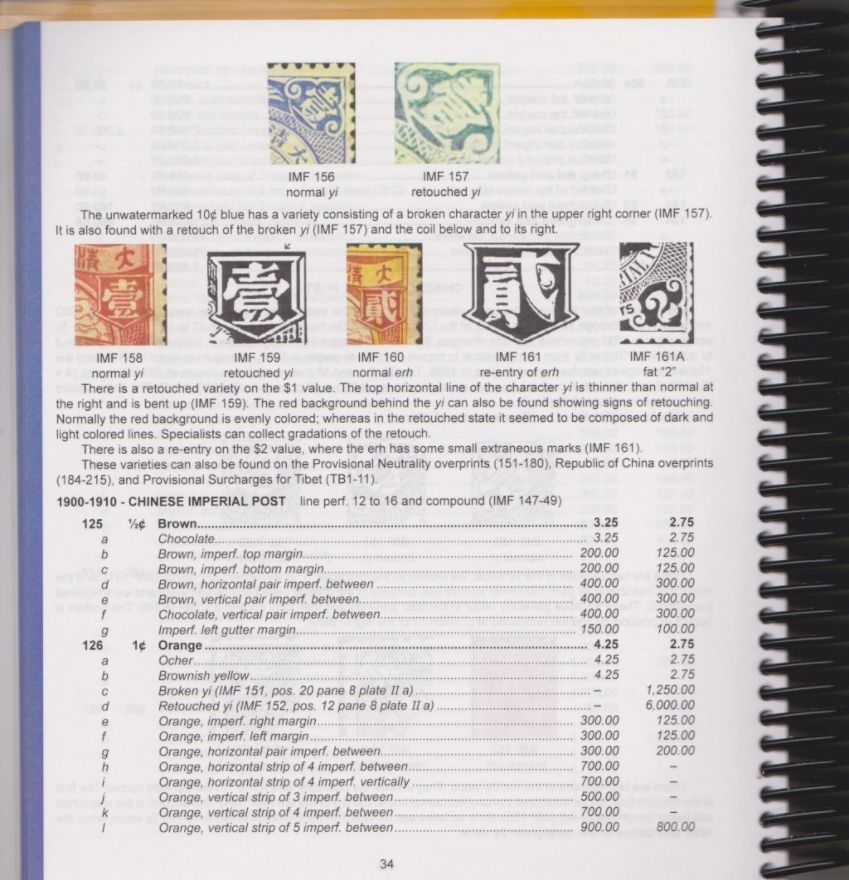
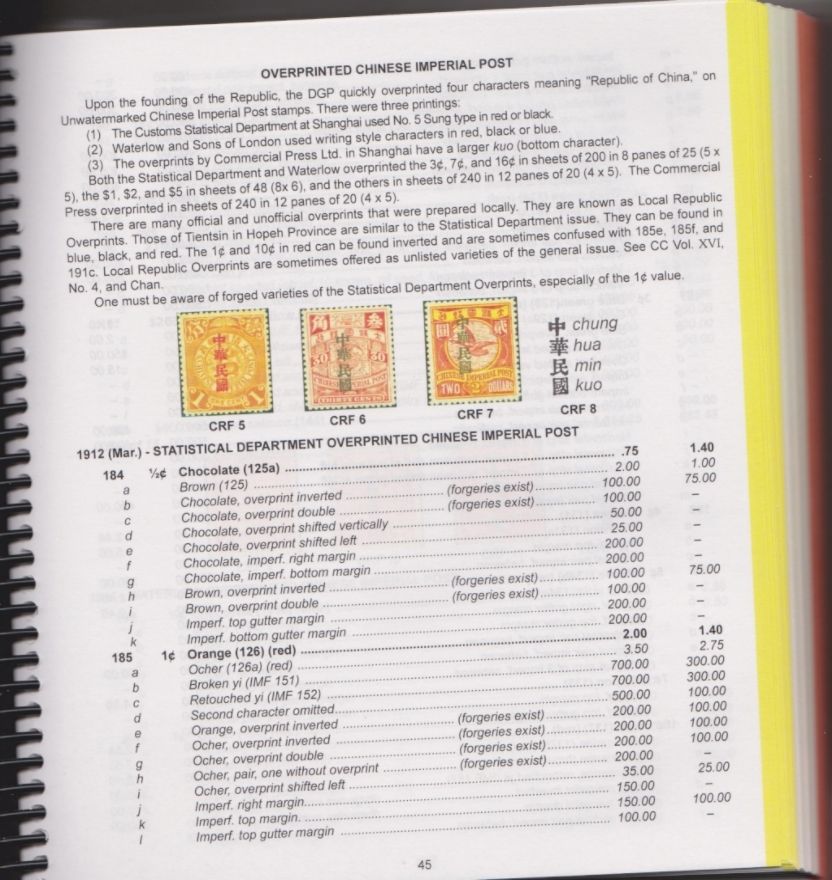

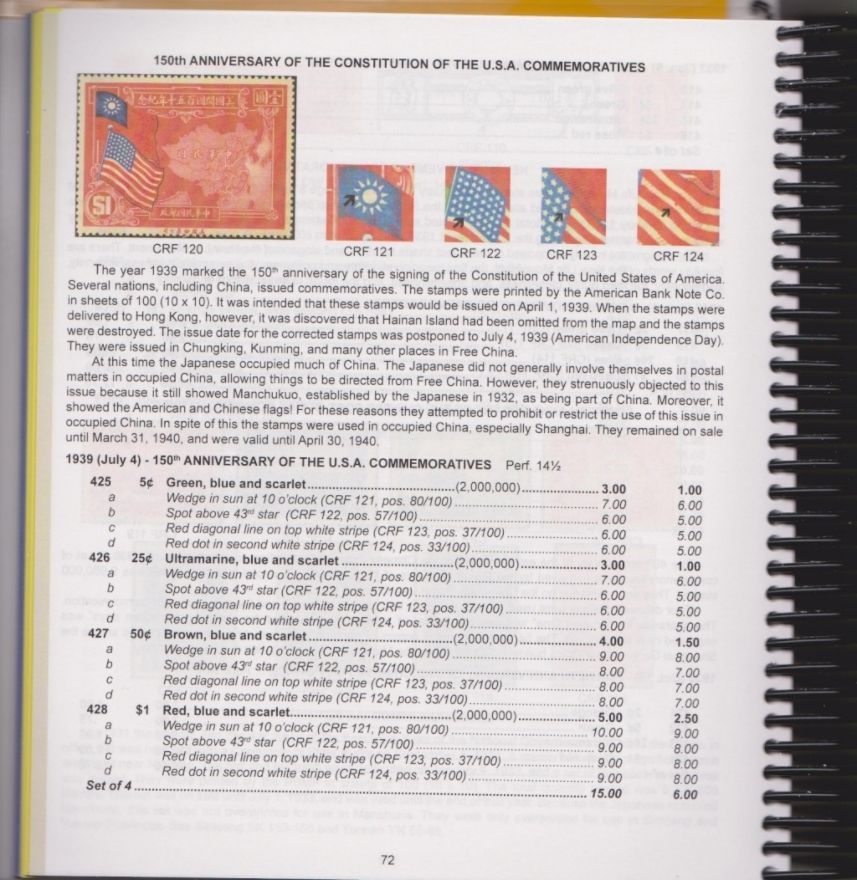
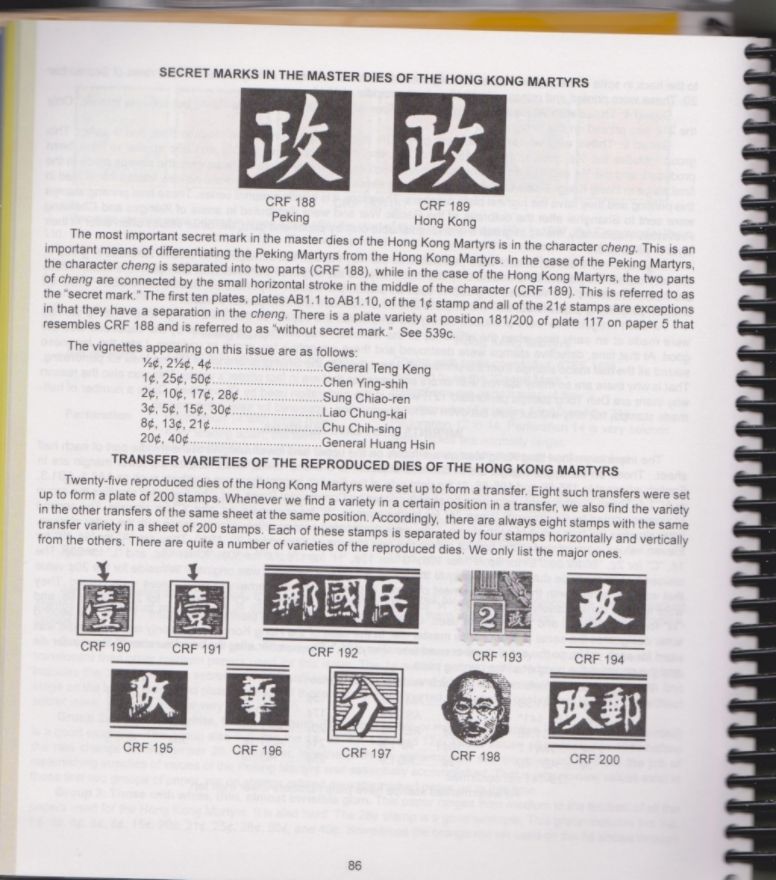
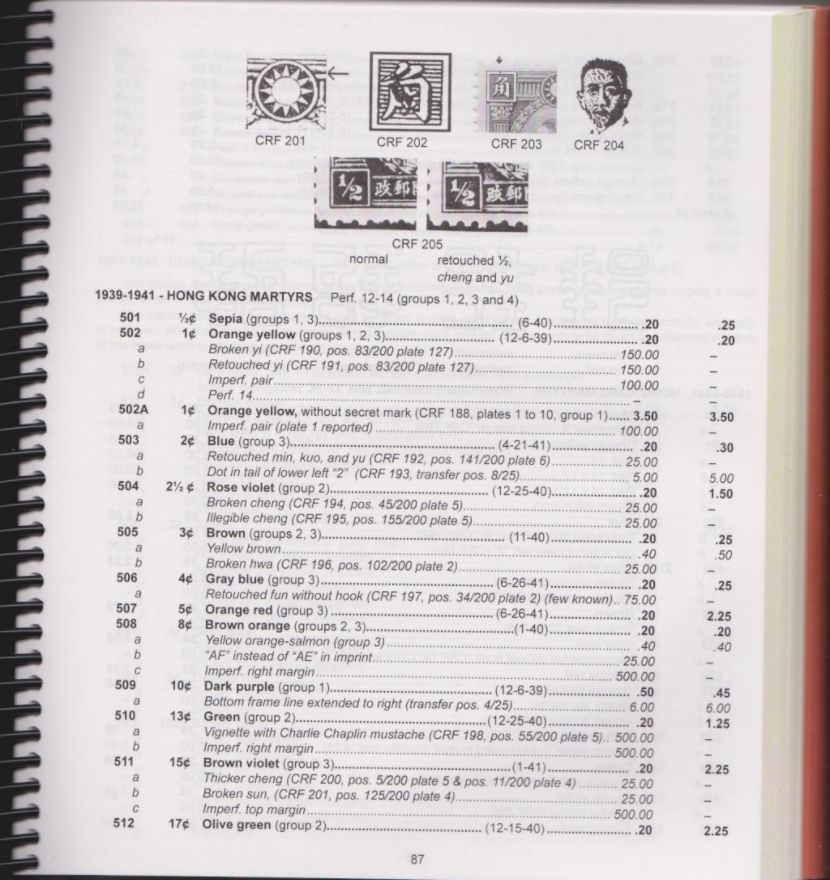
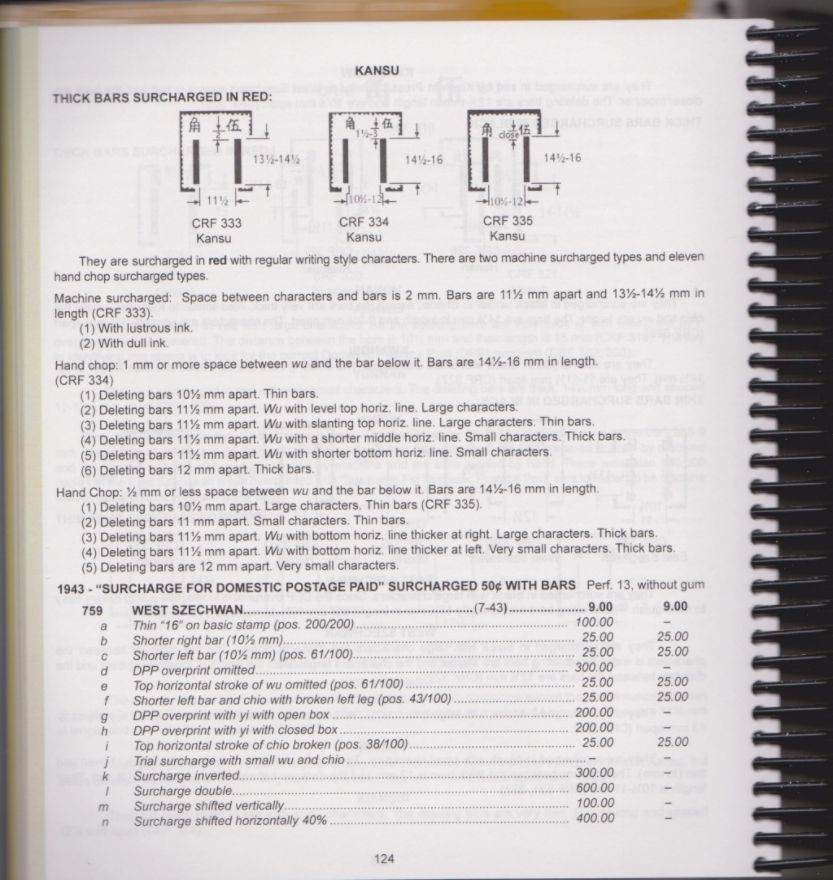
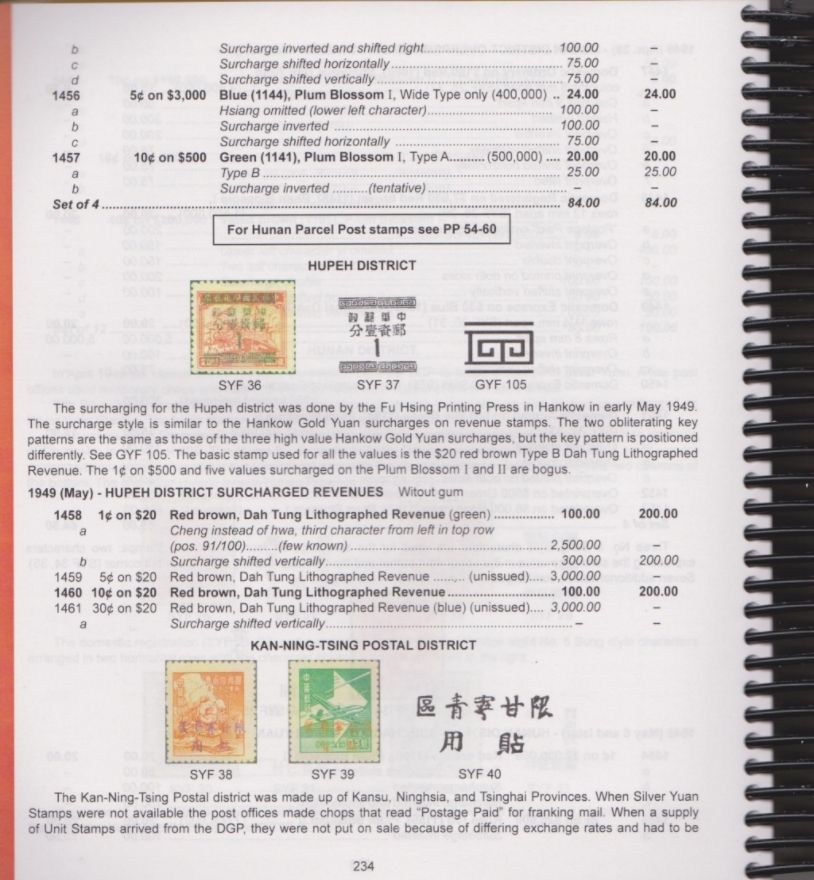

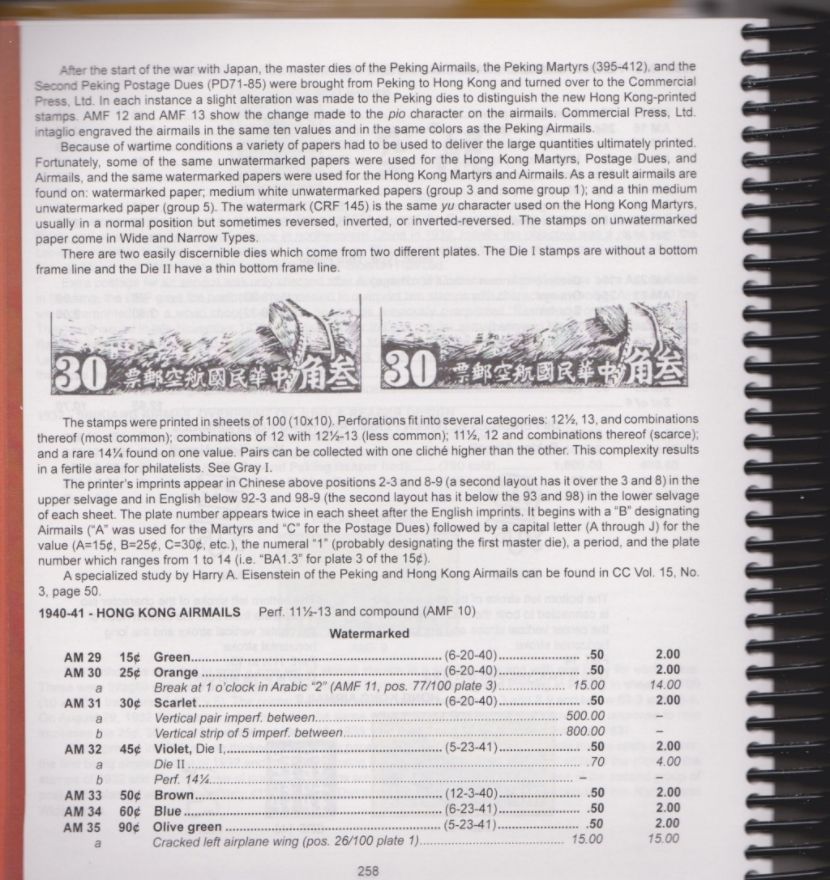
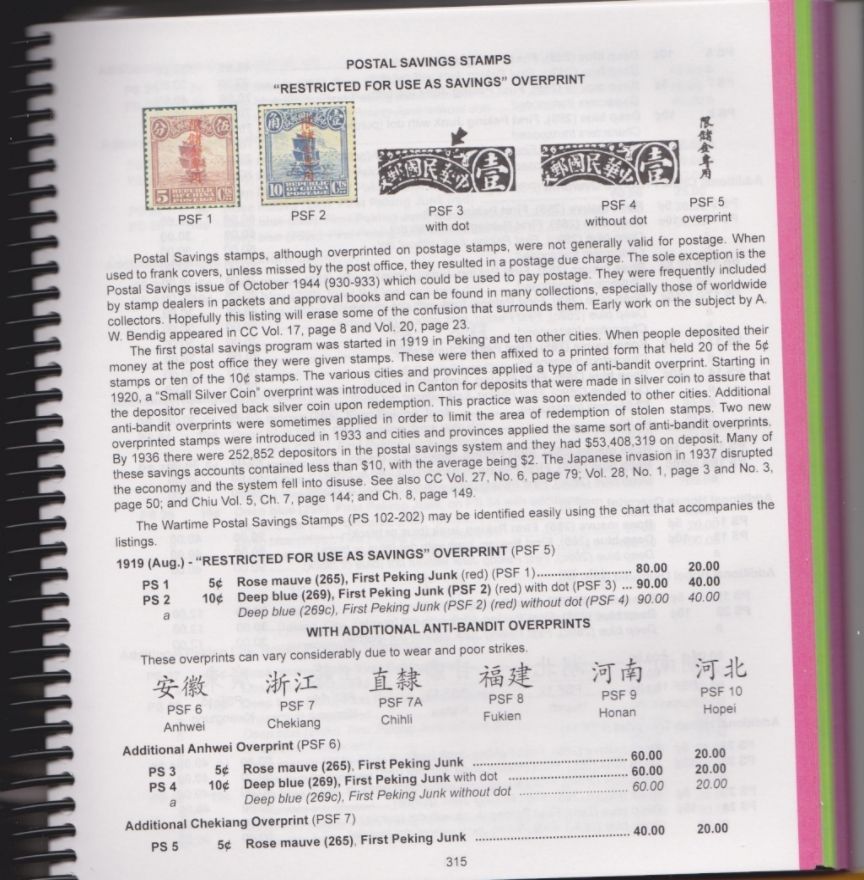

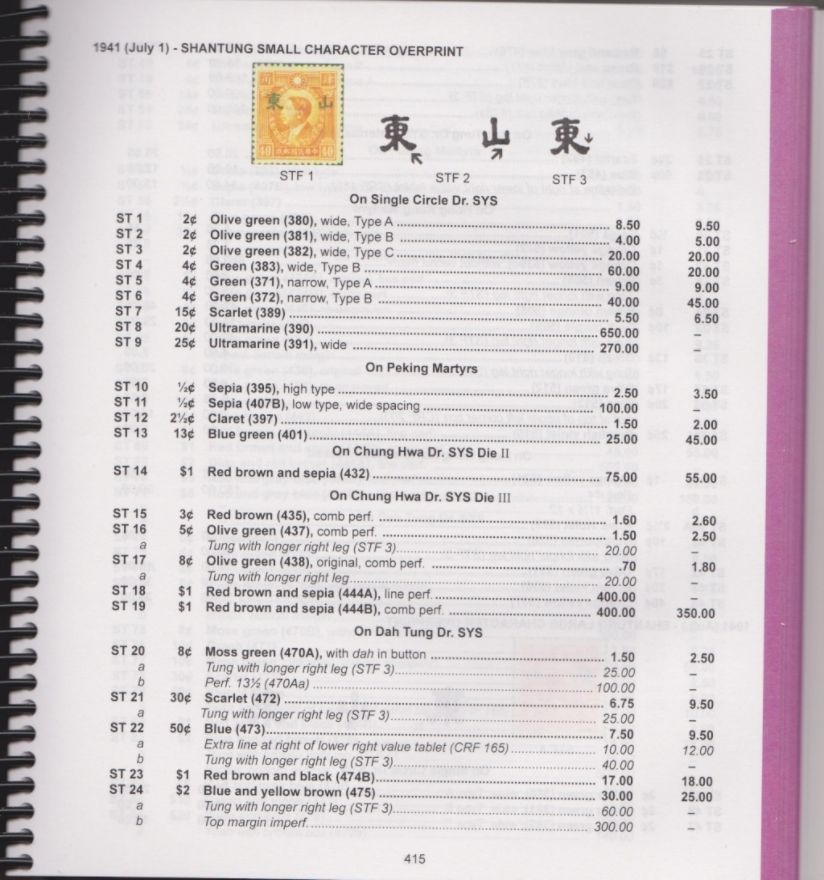
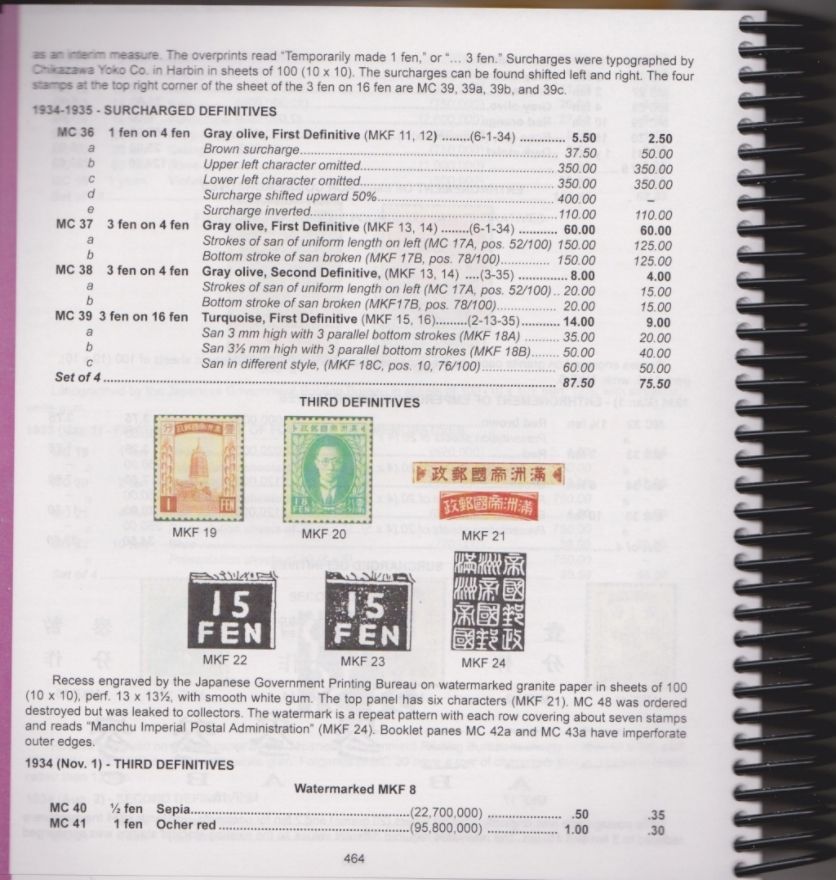
The China Stamps Society sells the catalog to members for US$59.99, with non-members paying a US$10 surcharge. Either way, it is worth every penny especially if you happen to have an old collection and start looking for varieties, that could pay for the cost of the catalog with just one or two lucky finds lurking in an old Big Blue.
Subscribe to:
Posts (Atom)